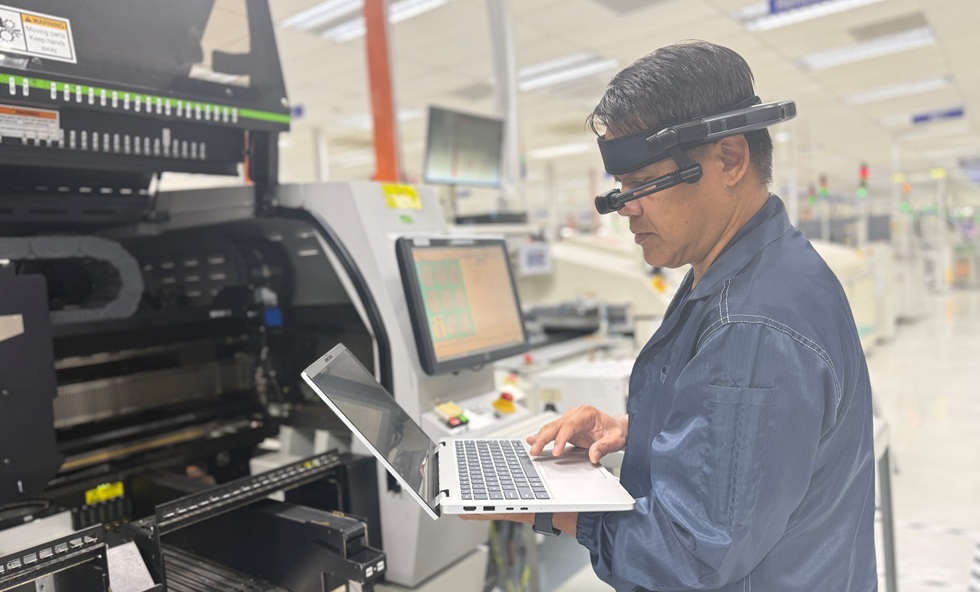
Rockwell Automation’s World Economic Forum-recognised Singapore factory demonstrates how digital twins and intelligent automation can overcome the limitations of an established industrial site. At Rockwell Automation Fair in Boston, Chief Technology Officer Cyril Perducat explained why successful transformation depends on understanding the physical factory before attempting to make it autonomous.
A factory spread across several floors has an unusual vulnerability. When materials cannot move between levels, production can grind to a halt even though every machine is functioning perfectly. The problem is particularly acute when elevators provide the only practical route for transporting components and finished goods, leaving an entire operation dependent on equipment that might otherwise be considered supporting infrastructure.
Rockwell Automation faces precisely this challenge at its Singapore manufacturing facility, where limited space has forced production into a vertical configuration. The site has been recognised by the World Economic Forum’s Global Lighthouse Network for its application of advanced manufacturing technologies, but its transformation is particularly interesting because those technologies have been applied within the limitations of an existing operation.
Cyril Perducat, Senior Vice President and Chief Technology Officer at Rockwell Automation, explained at Automation Fair how digital modelling allowed the company to rethink the factory’s physical organisation without the disruption associated with conventional redesign. “Before you break anything or you build anything, it’s not like a gigantic canvas of thousands of square metres that you can move things around,” he says. “You have the constraint of the space. Being able to model gives you the opportunity to model different settings in that space, and to be able to execute the redesign and the transformation of the factory in a much shorter timeframe than could have been done without the modelling.”
Singapore’s experience challenges the assumption that advanced manufacturing transformation requires a purpose-built facility. Existing factories present complicated engineering problems, particularly where established production processes must remain operational, but digital technologies can provide a way to improve performance without wholesale replacement.
Understanding the physical factory
Digital transformation programmes frequently begin with connectivity or data platforms, yet the physical arrangement of a manufacturing facility can determine whether a proposed improvement is achievable. At Singapore, Rockwell used its Emulate3D digital twin technology to model existing production areas and evaluate alternative configurations before committing to physical modifications. Engineers could assess how changes would affect material movement across the multi-storey facility, reducing the risk of discovering expensive constraints after equipment had been relocated or installed.
The elevators connecting Singapore’s production floors illustrate why this approach was necessary. In a conventional factory, materials might be diverted along alternative routes, but a vertical facility can depend on a handful of critical transfer points. The loss of an elevator affects far more than the equipment itself because manufacturing processes and warehouse operations span multiple floors. As Perducat explains, “You end up creating a very dangerous bottleneck in that factory because everything goes through the elevators. It’s not just that if you cannot take the elevators, you have to take the stairs. There is no plan B for robots. There is no plan B for pallets. There is no plan B for goods. If the elevator breaks, then your factory stops.”
Rockwell introduced AI-enabled predictive maintenance to monitor this critical equipment and identify developing abnormalities before they interrupted operations. The application demonstrates why the operational consequences of failure should influence decisions about where intelligent maintenance delivers the greatest value. An elevator contributes nothing directly to manufacturing a product, but its failure could prevent multiple production areas from receiving the materials they need.
Deciding when machines should act
Monitoring critical infrastructure creates another challenge once an abnormality is detected. The system must establish whether the problem can be addressed automatically or whether the circumstances require intervention from someone who understands the wider operation.
Singapore’s approach distinguishes between recognised abnormalities that automation can correct, conditions where the system recommends an action for human approval, and unfamiliar patterns that require an operator to investigate. These boundaries reflect the consequences of an incorrect decision rather than a desire to automate every possible activity.
Perducat describes the approach as a practical expression of autonomous manufacturing. “We have a certain number of anomalies that are identified that can be corrected directly by the system. We have recommendations in terms of actions that need to be done, but no activation of such action because that’s for human validation. And then you have certain tasks where a diagnosis is expressed, but it’s a pattern that has not been identified before, and it’s obviously for the operator to make a decision.”
Manufacturers therefore need not progress towards a single predetermined level of autonomy. Routine interventions can be automated where the appropriate response is understood, while employees retain responsibility for uncertain situations. Increasing the independence of equipment becomes a question of establishing trustworthy boundaries rather than simply introducing more sophisticated software.
Singapore’s deployment of approximately 50 to 60 autonomous mobile robots offers another illustration of this principle. The machines share space with employees and respond to people crossing their paths, rather than requiring completely segregated working areas. Unfamiliar visitors can initially find the arrangement unsettling, although confidence develops as they observe the robots behaving predictably. The wider lesson is that autonomous equipment must accommodate human activity within established production environments, rather than assuming that people can simply be removed from the process.
Measuring improvements in an existing operation
The commercial significance of Singapore’s transformation becomes clearer in the performance improvements reported by Rockwell. Perducat cited a 33% increase in labour productivity, a 25% improvement in quality and a 7% increase in overall equipment effectiveness. These results are particularly relevant because they were achieved within an established manufacturing operation, where available space limits opportunities to increase capacity through physical expansion.
Improving the performance of installed assets can release productive capacity without requiring manufacturers to purchase equivalent amounts of additional equipment. Perducat highlights this connection when discussing equipment effectiveness. “Seven per cent on existing assets. That’s value that you extract from your installed base or from your equipment without adding investment. You train people in a better way, get better processes, and then you can operate at a higher level of performance without needing to buy more. Seven per cent of efficiency means also seven per cent capacity.”
Better equipment performance is only part of the transformation. Experienced employees possess knowledge of how individual machines behave and how previous failures were resolved, but much of that expertise can remain inaccessible to colleagues. Singapore has introduced AI-supported knowledge systems that capture maintenance activities and established practices, allowing employees to retrieve guidance that previously depended on searching documentation or consulting experienced technicians.
The longer-term ambition is for software agents to use the same knowledge when assessing operational problems. “How do we capture knowledge and how do we capture information across different things so that every time there is a bit of learning, every time there is a new piece of information, it doesn’t just remain with one individual?” Perducat asks. “We create a modern version of a knowledge base that today people tap into, but in the future the same knowledge base will be able to be used by agents as a source of information and knowledge to drive different scenarios.”
Capturing expertise becomes especially important as automation reduces the time employees spend on routine interventions. Organisations must ensure that people continue developing the judgement required to manage unfamiliar problems, even as software becomes increasingly capable of resolving established ones.
Transformation without a blank sheet
Singapore provides an example of modernising infrastructure that was never designed around today’s digital technologies. Rockwell’s planned New Berlin facility in Wisconsin presents a different opportunity, with advanced manufacturing principles incorporated into a new factory from the outset. Lessons from Singapore will inform that development, although the engineering decisions will differ because New Berlin does not face the same legacy constraints.
Most manufacturers operate facilities closer to Singapore’s circumstances, where existing equipment and established processes determine what can realistically be changed. Perducat believes transformation must therefore begin with a company’s current capabilities rather than an assumption that every organisation should pursue the same technology roadmap.
“Even when you build a new factory, you have an existing factory. You have people that have been trained on some technologies, that have been trained on doing a certain process. Nothing is completely new,” he explains. “The ability to take customers where they are, what is their starting point, and to understand from where you are what is the next step, and then what is the next step, is really important.”
The same thinking applies to the changing responsibilities of the workforce. Employees who spend much of their day responding to minor operational problems have less opportunity to address complex challenges requiring collaboration and experience. Intelligent automation can relieve some of that pressure, but the objective should be to make human expertise more valuable rather than pursue the elimination of human involvement.
Singapore’s Lighthouse recognition provides external acknowledgement of what has been achieved, but its wider significance lies in the relationship between technological ambition and manufacturing reality. The site has improved performance by understanding how its physical constraints affect production and applying intelligence where it can change the outcome.
For manufacturers operating established facilities, that is a more useful vision of the factory of the future than replacing everything with autonomous equipment. The objective is to understand the limitations of the existing operation well enough to make the entire factory work more effectively.