As electricity demand accelerates and renewable generation reshapes power flows, transmission operators are under pressure to unlock capacity without waiting decades for new infrastructure. Belgium’s early adoption of dynamic line rating shows how smarter use of existing assets is becoming one of the most powerful tools in modern grid strategy.
As the first to deploy Ampacimon’s patented Dynamic Line Rating (DLR) technology, Belgium’s national transmission system operator Elia led the market with a more sophisticated approach to managing network capacity. Today it serves as a global case study in demonstrating how to reduce demands for capital investment by maximising the value of an existing asset base.
Electricity transmission and distribution network operators are facing a changing and increasingly challenging world. A growing proportion of renewables within the generation mix, which as often sited in remote locations, is one major issue. In Belgium, for example, the electricity system operator Elia recently reported that the national generation mix saw a 21% increase in solar generation during 2025. Over the same period installed onshore wind energy capacity grew by 13% to 3.6 GW.
Alongside changes in generation, demand is also shifting. New industries such as the emergence of data centres and the electrification of transport and industry is having profound repercussions across the energy sector and particularly as it relates to new requirements for the transmission and distribution system. New demands are driving up complexity, while capital budgets remain under pressure.
In response, system operators are investing heavily in expanding and upgrading the grid as well as using flexible connections and market mechanisms to free up more capacity. However, 20 years ago, a forward-thinking Belgian-based start-up understood this issue and launched a technology that would soon become a game changer for the power industry by enabling more efficient use of existing assets. Right there, in the very heart of Europe, Dynamic Line Rating (DLR) was born. Recognising the benefits, Elia led the charge on deploying these advanced grid enhancing technologies across its network. Today Elia serves as a global case study in demonstrating the advantages of dynamic line ratings.
The DLR breakthrough
DLR enables additional transmission capacity to be realised by more accurately assessing the available margins while still ensuring safety and reliability. The calculation of network capacity is largely based on thermal ratings for overhead lines. Higher temperatures can increase conductor sag, raising the risk of a fault by arcing to vegetation or coming in contact with grounded objects. To manage this risk, most Transmission Network Operators (TSOs) apply conservative seasonally adjusted ratings or ambient adjusted line ratings (AAR) based on likely temperatures found within conductors. Seasonally adjusted ratings, for example, are typically set for summer and winter and reflect conservative assumptions across the expected range of temperature conditions.
AAR provides a more advanced approach by adjusting line ratings using real or forecast environmental data, such as ambient temperature from weather stations and solar irradiance derived from IEEE or CIGRE algorithms. However, while adopting an AAR model enables more dynamic ratings than seasonal assumptions, it does not fully represent actual conditions along a transmission line. Such models do not account for all the factors that affect conductor temperature and thus capacity, particularly the cooling effect of wind. Even when wind is considered, highly localised influences such as nearby vegetation or buildings are difficult to model accurately, especially at wind speeds below 2 m/s.
Grid enhancing technologies like DLR systems represent a significant advance by using real-time measurements of actual conductor conditions, often combined with advanced weather forecasting.
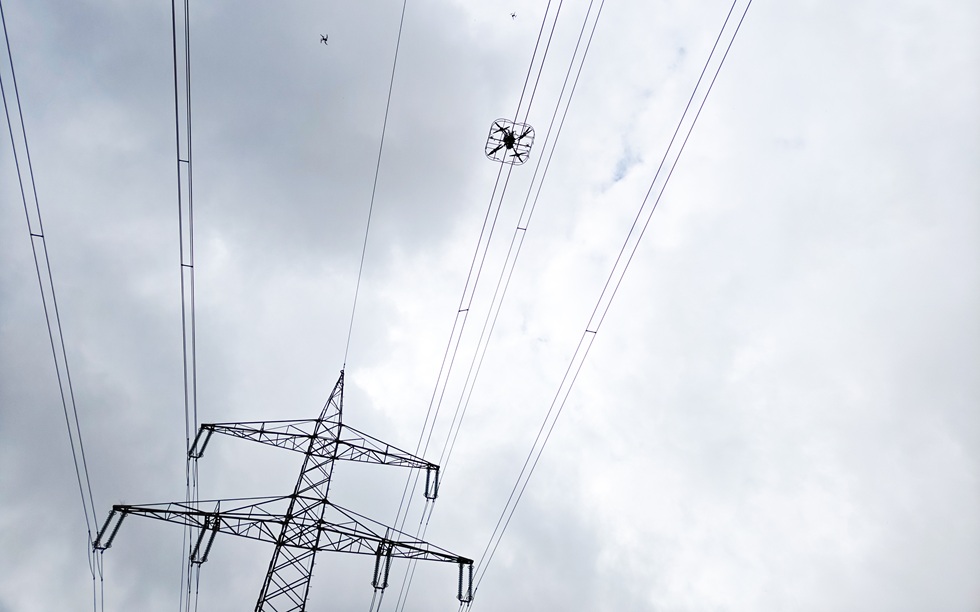
Based on its patented sensor technology, the Ampacimon DLR system uses accelerometers to measure conductor vibration caused by wind but which is also influenced by other factors. Sophisticated analysis of the vibration spectrum provides direct measurements of conductor conditions including the perpendicular wind speed and by inference its cooling effect. These real-time measurements are also typically integrated with weather forecasts to provide both current line ratings and forward capacity predictions. In its forecasting, Ampacimon applies probabilistic machine learning techniques to address limitations in weather models, particularly under low wind speed conditions. And, by basing line ratings on real-time data, Ampacimon’s DLR system can increase transmission capacity by up to 40% compared with static line rating approaches.
Built in Belgium, demonstrated to the world
From the earliest rollout, Elia has embraced the Ampacimon solution, allowing it to be demonstrated at scale and in real world scenarios. Working in partnership to address anticipated grid congestion as a result of static line ratings, Elia began working with Ampacimon in 2008. Subsequently it rolled out DLR technology across the network, adding it to several overhead lines in 2011 and by the winter of 2014-2015 had expanded this programme to eight of the critical overhead interconnectors with France and the Netherlands through which large power imports take place. The move, which sees dynamic line ratings transferred to Elia’s supervisory control and data acquisition system (SCADA) every five minutes and provides capacity forecasts 60 hours ahead, results in 30-40% flow increase on these key interconnectors. The development thus maximises import capacity and reduces the risk of load shedding.
Elia’s commitment to dynamic line rating is long standing and ongoing. Building on its early deployments, the Belgian transmission system operator continues to integrate DLR within its approach to managing network capacity, reinforcing its role as a core operational tool within the grid. Following the success of the cross-border transmission capacity increase, Elia began deploying Ampacimon technology elsewhere in its grid, notably to support increased wind development. Indeed, wind capacity is particularly well suited to benefit from DLR as stronger winds equate to both greater generation and simultaneously increased cooling.
With Elia and Ampacimon pioneering the use of DLR with its demonstrable and proven benefits, deployment of Ampacimon’s DLR technology quickly spread far beyond its Belgian birthplace. Today Ampacimon DLR technology is in widespread use across Europe, the USA and Asia where it is making a substantive improvement to the performance of the existing asset base. Belgium’s minister of Energy, Mathieu Bihet, is now set to put his own seal of approval on Ampacimon’s breakthrough technology with a visit to the company’s headquarters on 9 January 2026.
Looking ahead it is clear that the challenges grid operators face will continue to grow. In Belgium, for example, cross border energy flows are on the rise, increasing by 14 TWh during 2025. Meanwhile, applications to connect to the distribution and high-voltage grids have increased by a factor of four and six respectively over the last five years. As a result, projects are having to wait longer for a connection and grid congestion continues to grow. At the same time, in recent years, study applications amounting to 70 TWh of data centre demand have been submitted whereas total national demand for Belgium is around 80 TWh. While perfectly illustrating the issues, Belgium is certainly not alone but by taking the decision to work smarter rather than just harder it has proven that there are alternatives to simply ramping up capital expenditure. As an early adopter, the Belgian TSO worked with Ampacimon to make the most of its existing asset base and others quickly followed suit. Today the benefits of DLR are much more broadly understood and the technology is being embraced wherever grid constraints challenge system operators. What began in Belgium now belongs to the world.