Mark Venables reports as Bill Sarver, Sr. Global Industry Consultant at Rockwell Automation, outlines an ambitious vision for transforming manufacturing through digital integration, AI, and industry-specific solutions at Rockwell Automation Fair in Anaheim
Bill Sarver, Sr. Global Industry Consultant at Rockwell Automation, presented a compelling and expansive vision for the future of manufacturing at the Rockwell Automation Fair. His discussion revolved around the ongoing digital transformation journey, highlighting agile operations, streamlined engineering, and optimisation, all in pursuit of the next generation of manufacturing efficiency. Throughout his presentation, Sarver provided insightful commentary on how technology, when implemented thoughtfully, can fundamentally change the way manufacturing is approached, and he made use of numerous examples and specific applications to illustrate his points.
A vision for the future of manufacturing
Sarver began by setting the stage: the manufacturing sector is undergoing profound changes driven by electrification, software-defined vehicles, and emerging concepts like software-defined manufacturing. These innovations are poised to revolutionise the way factories operate, fundamentally transforming the entire automation and architectural landscape. Although many of these ideas are still in the conceptual stage, industry leaders are beginning to take note, signalling the direction for future growth and adoption.
“It is important to understand that we are not just talking about small, incremental improvements here,” he says. “We are talking about a paradigm shift that will fundamentally alter how we approach manufacturing. This is not just about improving efficiency by a few percentage points, it is about rethinking the entire approach to manufacturing, from design through production and beyond.”
Software-defined vehicles represent a major shift not only for the automotive sector but for the entire manufacturing ecosystem. “The concept of a software-defined vehicle is making its way onto the manufacturing floor,” he explains. “We are starting to think about software-defined manufacturing as well, which has the potential to upend conventional approaches to automation. This means that instead of designing a factory around fixed processes and rigid systems, we can design it to be flexible and adaptable, driven by software that can be updated and improved continuously.
“This evolution demands new methods of building automation systems, new architectures, and fresh thinking about how different elements integrate and work together.” Sarver stressed that Rockwell Automation is positioning itself at the forefront of these developments, noting, “We are investing heavily in the tools, technologies, and partnerships that will enable this transformation. It is not an easy path, but it is the direction that the industry is heading, and we are committed to leading the way.”
A journey defined by digital integration
One of the central themes of Sarver’s presentation was the idea of a digital thread. This digital thread comprises an integrated flow of data that links every aspect of the manufacturing process, from product design to final production operations. According to Sarver, Rockwell is uniquely positioned to execute on this digital thread in a holistic manner. “We have a complete digital thread, and a lot of our competition simply cannot say that,” he continues. “This digital thread allows us to connect every stage of the product lifecycle, from the initial design phase all the way through to production and even maintenance. By having this continuous flow of data, we are able to make smarter decisions, respond to changes more quickly, and ultimately deliver better outcomes for our customers.”
This integration means that all aspects of the product lifecycle management (PLM) data, including product design, digital twin, and testing, are seamlessly fed into the manufacturing execution system (MES), ensuring that engineering processes are streamlined and that products reach the market more quickly.
“Our real challenge is not the technology itself but rather how we integrate the various technologies,” Sarver says. “The challenge today is how we bring together these data models and achieve a truly integrated flow of information. It is not enough to have the best tools in the world if they do not talk to each other effectively. We need to ensure that data flows seamlessly across the entire organisation, from engineering to operations, to quality control, and beyond.”
This process involves connecting disparate systems, from PLM to MES and ultimately to the plant floor, in an efficient and interoperable manner. “Speed to market is a critical driver for all of us,” he explains. “Everyone is engaged in capacity planning, expanding, moving, and shifting production around the globe. To achieve this, we need to get better at managing our supply chains and ensuring traceability. It is about having visibility at every step of the process so that we can identify bottlenecks, predict issues before they occur, and ensure that we are always moving forward efficiently.”
Cloud, hybrid, and operational agility
Sarver also addressed the role of cloud and hybrid architectures in digital manufacturing. He was clear that cloud solutions are not a one-size-fits-all approach. “Cloud does not fit everywhere,” he notes. “It is not usable everywhere throughout an organisation. You must understand what best operates in the cloud, what best works in a hybrid environment, and what needs to remain on-premises. This is not just about technology, it is about understanding the unique needs of each operation and finding the right solution for those needs.
“The focus should be on blending traditional on-premises, hybrid, and cloud technologies to create an architecture that best fits operational requirements. It is about creating a seamless ecosystem where data can move freely, where we can leverage the power of the cloud when it makes sense, but also keep things close to the operation when that is what is needed.”
Rockwell Automation takes an operational-first approach, always prioritising how data is used, integrated, and leveraged to create value. This approach includes moving data between cloud, hybrid, and on-premises systems to enable efficient plant operations and manage complex information flows. “We are not a PLM company, and that is okay,” he says. “Our focus is on operations, on how to use the data, how to bring it together, and what needs to be used on the platform to bring real value.
“The key is not just having data but being able to turn that data into actionable insights that improve operations, reduce downtime, and ultimately drive profitability. Rockwell’s mission is to create a completely integrated solution that drives value for its customers. Our goal is to help our customers achieve their operational goals by providing them with the tools and insights they need to succeed.”
Enabling autonomous operations through data
Rockwell is committed to moving towards autonomous operations. Sarver spoke at length about Rockwell’s experience with artificial intelligence (AI) and machine learning (ML), using these technologies to optimise processes such as predictive maintenance. “We have been running AI on the plant floor for about eight years now,” he notes, adding that Rockwell has been using model predictive control for over twenty years. “This is not new to us as an organisation. We have been implementing these systems for a long time, and we are now working to expand and deepen our capabilities. The key is to move from simple automation, where a machine performs a task repeatedly, to autonomy, where a system can learn, adapt, and improve over time.”
The ultimate goal, is not just automation but genuine autonomy, where systems learn, adapt, and adjust to changing environments in real-time. He spoke about the importance of containerisation and microservices in enabling agile manufacturing. “Containerisation is something that has been common in the IT world for a long time, but it is relatively new in manufacturing,” he says. “By using containerised applications, we can make our operations far more flexible. We can update individual components without disrupting the entire system, we can deploy new features more quickly, and we can ensure that our systems are always running the most up-to-date software.
“This ability to make incremental changes without significant disruption is a key advantage in the fast-moving world of modern manufacturing. We need stability and agility to come together in our designs,” he adds, stressing that manufacturing environments must be designed to accommodate both change and consistency where required. “It is about knowing where you need stability and where you need flexibility, and designing systems that give you the best of both worlds.”
Industry-specific solutions and standards
Sarver also spoke extensively about Rockwell Automation’s efforts to create industry-specific solutions and the importance of standardisation in manufacturing processes. He explained that while every manufacturer has slightly different needs, there are many foundational processes that are similar across industries.
“The whole idea is to develop standard libraries designed for specific industries,” Sarver explained. “We have our Rapid Launch standard for automotive, which we are also extending to batteries and potentially to tyres. This is about simplifying operational sequences, standardising safety systems, naming conventions, and HMI screen development—all to make automation more straightforward and more efficient. By creating these standard libraries, we can help our customers get up and running more quickly, reduce the amount of custom engineering required, and ensure that they are starting from a solid, proven foundation.
“We are already working with five different automotive customers, three legacy and two new entrants, and we are seeing significant improvements in terms of design time and efficiency. The key here is not just about speed but also about quality. By using standardised components, we can ensure that everything is tested, everything is reliable, and everything works together as it should.”
Sarver also stressed the importance of simplifying the engineering process, describing Rockwell’s Data Circle of Life approach, which integrates engineering data into operational workflows to drive continuous improvement. “Engineering data becomes operational data, and this operational data is then used to inform engineering decisions, that is the data circle of life,” he adds. “It is a continuous feedback loop that allows us to learn, adapt, and improve at every stage of the process. It is about taking the lessons learned on the plant floor and feeding them back into the design process, so that every iteration is better than the last.”
Many legacy manufacturers still have a multitude of disconnected systems that create unnecessary complexity. “Our whole idea is to reduce complexity and bring it down to a few integrated systems that are designed to work seamlessly together,” he continues. “When you have dozens or even hundreds of different systems, each with their own data models, their own interfaces, and their own requirements, it becomes almost impossible to achieve the level of integration and optimisation that is needed today. By reducing the number of systems and ensuring that those systems are fully integrated, we can help our customers achieve a level of efficiency and agility that simply was not possible before.”
Moving from automation to autonomy
Sarver closed his presentation by outlining the journey from automation to autonomy. He defined autonomy as a system that not only performs tasks but also learns and adapts to changing environments. “Autonomy is about moving beyond simple automation,” he explains. “It is about having systems that are capable of making decisions, that can learn from experience, and that can adapt to changes in the environment.”
He described Rockwell’s ambition to achieve this kind of operational autonomy, noting that the journey will look different for each company and industry. “We are not going to hit everything at the same time in the same place, but we are working to create a road map for our customers to reach autonomous manufacturing,” he says. “It is about understanding where you are today, where you want to go, and then creating a plan to get there. It is not something that happens overnight, but with the right strategy and the right tools, it is achievable.”
A striking example of a lights-out manufacturing facility is a plant operated by Fanuc Robotics where robots are building robots in a fully automated process. However, Sarver made an important distinction: “Lights-out manufacturing is not the same as an autonomous factory,” he notes. “Lights-out manufacturing is about performing repetitive tasks efficiently, but it does not learn, it does not change, it does not adapt to quality variations or changes in demand. Autonomous manufacturing is about adapting and evolving based on real-time information. It is about having systems that can detect when something is wrong, that can adjust their behaviour accordingly, and that can continuously improve over time. That is the real goal, and that is what we are working towards.”
Real-world applications and AI integration
Sarver discussed in detail the role of AI in Rockwell’s strategy. “Everyone is talking about AI and generative AI, and we have been implementing these technologies for years. We have been running predictive models, AI, and ML on plant floors for nearly a decade. The key to using AI effectively is not just about having the technology, it is about understanding where and how to apply it to create real value. We are using AI to optimise production processes, to predict when equipment will need maintenance, and to ensure that we are always running at peak efficiency.”
Sarver provided examples of how these technologies are being used to optimise operations, including a tier one supplier that used AI to optimise labour scheduling, leading to a 30 percent improvement in operational efficiency. “Instead of having supervisors manually assign tasks, we now use AI to schedule workers automatically,” he explains. “The system knows who is available, understands their skills, and assigns them to tasks that maximise productivity. This has not only improved efficiency but also reduced the workload on supervisors, allowing them to focus on more strategic tasks. It is a perfect example of how AI can be used to create value across multiple levels of an organisation.”
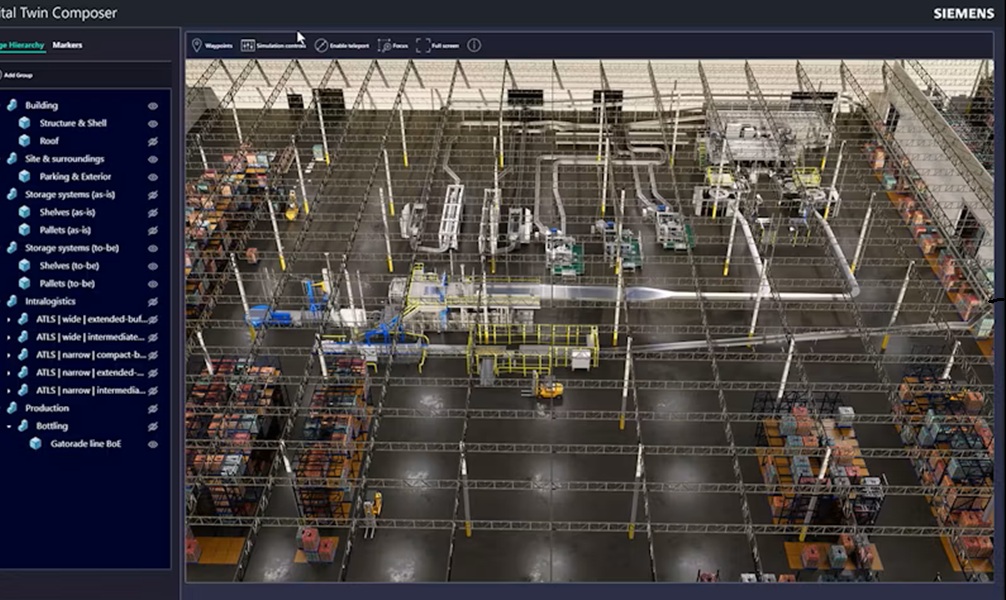
Sarver also highlighted the role of digital twins and emulation. “Simulation is based on models, and every model has an error,” he adds. “Emulation, on the other hand, uses the real code of the production environment, providing a more accurate digital twin. Rockwell is focused on using emulation to create true digital twins that allow for more effective virtual commissioning, operator training, and testing. This is not just about simulating a process, it is about virtually commissioning a real production environment. It means that we can test everything before it goes live, we can identify issues before they occur, and we can ensure that when we do go live, everything works as expected. It is a game-changer in terms of reducing risk and ensuring quality.”
Driving manufacturing forwards
Rockwell Automation’s strategic vision is to drive the manufacturing industry forward, from automation to autonomy, integrating data from engineering to operations, and creating industry-specific standards that enable a streamlined, agile, and optimised manufacturing ecosystem. The vision is ambitious but grounded in Rockwell’s deep expertise and ongoing commitment to innovation. “Our goal is to create a future where manufacturing systems are fully autonomous, where data drives every decision, and where our customers can achieve true operational excellence,” he concludes. “We are not just talking about incremental improvements here—we are talking about a complete transformation of how manufacturing is done. It is a big goal, but we believe that with the right tools, the right strategies, and the right partnerships, it is achievable.”