IFS has introduced a range of industrial AI capabilities at IFS Unleashed in Orlando, spanning enterprise intelligence, automated workflows and warehouse management. The announcements highlight the company’s plans to make AI an integral part of industrial operations while retaining control over how intelligent systems access information and execute decisions.
IFS has unveiled a series of technologies intended to change how manufacturers use enterprise software, access operational information and coordinate activities across their businesses. The announcements at IFS Unleashed in Orlando, Florida, on October 13 included IFS Intelligence, an Industrial AI Harness designed to govern AI agents and Fulfillment Flow, a new approach to warehouse management developed by IFS Softeon.
The centerpiece is IFS Intelligence, a platform that allows employees to question operational information using natural language and initiate activities within existing enterprise systems. It brings together information from assets, work orders, production schedules and operational records, drawing on both IFS applications and connected third-party systems.
Mark Moffat, CEO of IFS, told delegates that manufacturers hold considerable amounts of operational information, but much of their most valuable knowledge resides with experienced employees rather than in digital systems. Capturing that expertise and making it available more widely could help businesses improve productivity and reduce their dependence on individual specialists. “The most valuable dataset in your business has never been uploaded. It clocks in at 5am every day,” he said, referring to the employees whose knowledge and experience keep industrial operations running.
For manufacturers managing multiple enterprise applications, the challenge is often bringing together information that is distributed across production, inventory, maintenance and financial systems. Establishing why an order is at risk, for example, may require employees to examine material availability, production capacity, supplier commitments and delivery arrangements before deciding how to respond.
IFS Intelligence is designed to bring those activities into a single environment through three capabilities. Cowork provides a conversational interface for investigating operational information, creating continuously updated views known as Lenses and preparing actions for approval. Loops allows defined workflows to be delegated to digital workers, while Runway is intended to accelerate software migration, configuration and development.
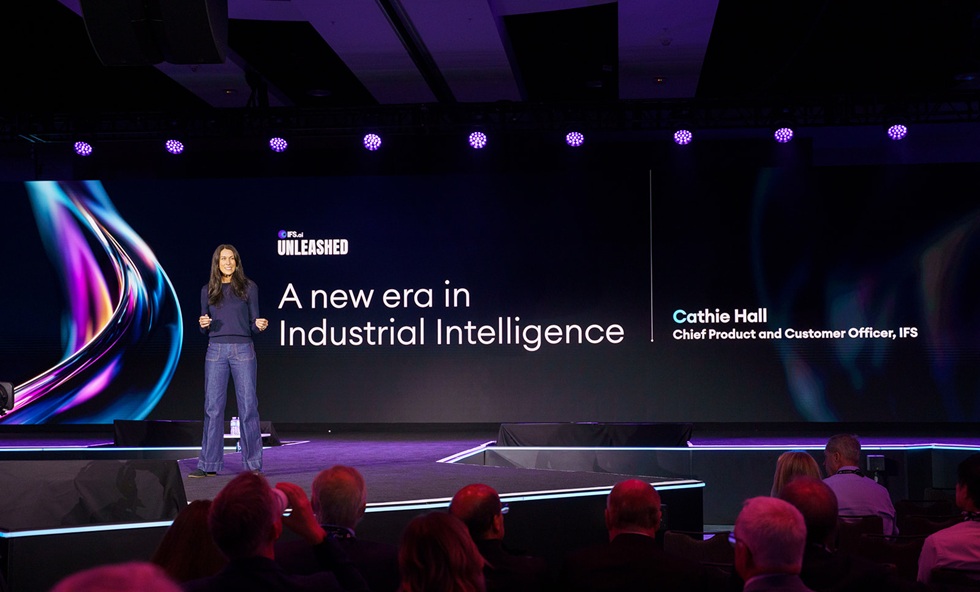
Cathie Hall, Chief Product and Customer Officer at IFS, explained during a press briefing that businesses often struggle to extract timely information from their existing enterprise systems, despite substantial investment in reporting and analytics. “Companies have invested in new systems, built business intelligence teams and developed dashboards, yet they still struggle to get the information they need. When a report raises further questions, employees often have to request additional analysis, which can take weeks to produce. By the time they receive the answers, the information may no longer be relevant.”
The technology is intended to allow employees to investigate successive questions without commissioning additional reports. IFS also demonstrated how information obtained through conversational interaction could be used to develop recommendations and prepare activities for approval.
Hall believes AI could fundamentally change how businesses access and use information held within their enterprise systems. “Companies have more data than ever before, but they have struggled to turn it into useful insight. AI will allow employees to explore that information more naturally, asking questions and receiving answers relevant to their individual needs rather than relying on the same standard reports and dashboards.”
Governance becomes central to industrial AI
Alongside IFS Intelligence, the company introduced its Industrial AI Harness, designed to govern how digital workers interact with enterprise applications and operational information. The technology addresses the additional requirements created when AI systems move beyond providing recommendations and begin preparing or executing activities that affect business operations.
The Harness combines planning and orchestration, system connections, operational context, permissions, verification and auditing. It is designed to ensure that AI agents operate within established business rules and cannot access information or perform actions beyond their authorized responsibilities.
Hall emphasized during her press briefing that recording an AI agent’s actions after they have occurred is insufficient when the consequences could affect critical operations. “We need to make sure that every entry point has the same permissions, business rules and audit trail as the people working in the organization. It cannot be a case of allowing something to happen and then deciding it is acceptable because there is an audit trail. The controls must be built into every stage of the process.”
The system is intended to support different levels of autonomy, allowing digital workers to begin by assisting employees before progressing to recommendations and approved actions. Where an activity requires additional judgment or falls outside established permissions, the application is designed to escalate the decision for human review.
IFS also wants these controls to apply across connected applications and third-party digital workers, reflecting the reality that manufacturers often operate enterprise systems from multiple suppliers.
The need for stronger governance was reinforced by findings from the IFS Industrial Index 2026, also released at the conference. The research surveyed 2,275 executives and frontline workers across several industrial sectors, including manufacturing, and found that 43 percent of respondents had introduced agentic digital workers into everyday operations during the previous year.
However, only 11 percent reported validating AI outputs for safety-, quality- or mission-critical processes, while just four percent had implemented mandatory human oversight or approval requirements for AI-supported decisions.
Toby Rees, Global Head of AI Trust at IFS, said the ability to govern AI activity would become increasingly important as industrial organizations expanded their use of intelligent applications. “From auditable processes and transparent governance to the ethical use of AI, IFS treats trust as a fundamental requirement, not an ambition. As organizations scale AI across critical assets, supply chains, service operations and enterprise workflows, success will depend on the ability to combine intelligence with context, control, accountability and operational discipline.”
Warehouse intelligence moves beyond individual tasks
IFS also announced Fulfillment Flow from IFS Softeon, extending its industrial AI strategy into warehouse operations. The capability is designed to help managers understand how decisions in one part of a facility affect activities elsewhere, including inventory movements, labour allocation, automation and outbound shipments.
Warehouse management systems already collect extensive information about orders, inventory, equipment and employees, but operational decisions are frequently made within individual functions. Improving performance in one area can create additional pressure elsewhere, particularly when resources or processing capacity are constrained.
Fulfillment Flow uses digital workers assigned to different warehouse activities, including inbound operations, wave management, labour, automation, slotting, replenishment and outbound movements. These agents share information with a central operational agent that is intended to evaluate decisions against the requirements of the wider facility.
Mark Fralick, Chief Technology Officer at IFS Softeon, explained that the objective was to provide managers with information about the causes of operational problems rather than simply reporting their existence. “Fulfillment Flow brings AI directly into the flow of warehouse operations, where decisions are being made every day. By connecting AI with the real-time context of the warehouse, we can help teams move from identifying an issue to understanding what is driving it and determining how to respond.”
The platform is designed to consider factors such as available labor, equipment capacity, service commitments and operational conditions when recommending a response. The warehouse manager retains responsibility for setting priorities and approving decisions, while the system continues monitoring developments as circumstances change.
Fralick argued that understanding the relationships between warehouse activities is essential if AI is to support effective decision-making. “A generic AI system may be able to tell you that orders are behind schedule, but the real value comes from understanding what is driving that situation, what other operational factors are involved, and what can be done about it. The warehouse manager stays in control.”
For manufacturers, the potential applications extend beyond finished goods distribution. Warehouse activities are connected to production through raw material availability, work-in-progress movements and component replenishment. Decisions affecting inventory or labour allocation can therefore influence manufacturing schedules as well as customer deliveries.
Fulfillment Flow is intended to assess those relationships when making recommendations, although the announcement does not establish what operational improvements customers can expect from a completed deployment.
The announcements at IFS Unleashed reflect the company’s intention to extend AI beyond conventional analytics and into the execution of industrial processes. Conversational access to business information, coordinated digital workers and warehouse intelligence could reduce the effort involved in investigating operational problems and carrying out routine activities.
Manufacturers will nevertheless need to evaluate how these capabilities operate within their existing technology environments, including the quality of available information, the reliability of automated actions and the costs associated with wider deployment.
IFS has outlined how it intends to address these requirements through its new intelligence platform and governance architecture. The next test will be whether manufacturers can translate those capabilities into sustained improvements in production, maintenance and supply chain performance.