Manufacturers are demanding more from industrial robots as production requirements become increasingly complex. Higher output must be achieved without compromising precision, while rising operating costs and pressure on factory space are forcing manufacturers to reconsider how automation equipment is designed and deployed.
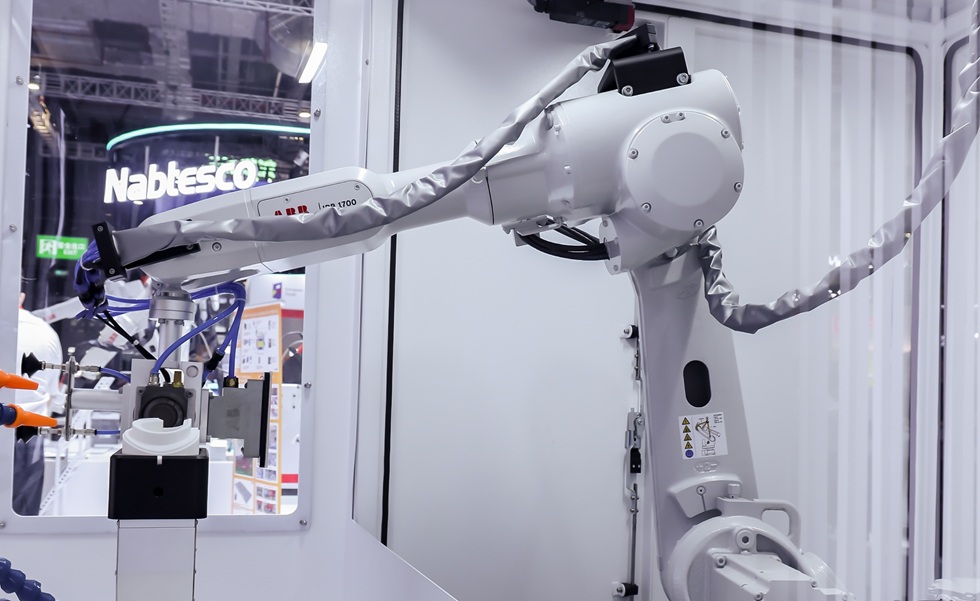
ABB Robotics has introduced two industrial robots, the IRB 1700 and IRB 1700ID, designed to address these competing requirements in sectors including automotive, electronics and general manufacturing.
The new robots offer payloads ranging from 6kg to 12kg across five variants, with ABB claiming cycle times up to 20% shorter than comparable robots. Powered by the company’s OmniCore controllers, they combine high-speed movement with path repeatability down to 0.03mm, making them suitable for applications where production speed and consistent positioning are critical.
The range is intended for manufacturing processes including material handling, arc welding, deburring, sanding and machine tending. ABB also identifies AI server rack assembly as an emerging application, reflecting the demands that new computing infrastructure is placing on precision manufacturing.
Alongside performance, the development places considerable emphasis on the physical and operating constraints of modern factories. The IRB 1700 occupies a footprint 50% smaller than its predecessor, potentially allowing manufacturers to introduce additional automation within existing production environments.
The IRB 1700ID takes this approach further through an integrated dressing design that routes cables and hoses internally through the robot arm. This reduces external cabling requirements and simplifies installation, an important consideration in production cells where equipment must operate within restricted spaces.
Energy consumption and maintenance have also been addressed. ABB reports that the IRB 1700 consumes up to 15% less power than the previous IRB 1600 when operating with the same payload and OmniCore controller. Oil-change intervals can extend to 20,000 operating hours, potentially reducing maintenance requirements and associated production interruptions.
The robots also form part of ABB’s broader development of more autonomous and versatile robotic systems. They provide access to the company’s expanding software portfolio, including RobotStudio, AI Robot Trainer, OmniCore EyeMotion and automatic collision-free path planning.
This combination of mechanical performance and software capability reflects the growing importance of programming and operational flexibility in industrial automation. Manufacturers increasingly need robotic systems that can accommodate changing production requirements without excessive engineering effort.
The IRB 1700 and IRB 1700ID made their public debut at the China International Industry Fair in Shanghai in October, demonstrating arc welding and sanding applications.
For manufacturers evaluating automation investments, the development illustrates how improvements in productivity increasingly depend on several interconnected factors, including motion accuracy, equipment footprint, energy efficiency and the software used to configure and operate robotic systems.