The RB17 pushes manufacturing to Formula One extremes. The result is a 1,200-horsepower machine built with uncompromising detail, designed to deliver ultimate track performance at scale.
There is a particular irony to the RB17. Officially, it is the car that never raced. A gap-filler between Red Bull Racing’s 2020 and 2022 Formula One campaigns was bypassed due to COVID-era constraints. Yet, in many ways, it may become the most essential car the team has ever produced.
A two-seat, track-only hypercar, the RB17 represents the distilled DNA of nearly two decades of engineering at the absolute edge of motorsport. It is a culmination of lessons learned from Grand Prix victories and wind tunnel calibrations, from failures under pressure and breakthroughs under even greater pressure. Rob Gray, Technical Director of Red Bull Advanced Technologies, has spent his career threading those lessons into design. But with the RB17, the stakes have shifted. What begins as a passion project has become an extreme test of how Formula One thinking can shape advanced manufacturing beyond the paddock.
Designing the missing link
The RB17 was named to fill a numeric void. When the 2021 Formula One season reused the RB16 chassis due to pandemic cost caps, the next car became the RB18, leaving the designation unclaimed. At the same time, Red Bull Advanced Technologies was quietly designing something different.
“The idea was to build a car that applied everything we had learned from Formula One and package it into a vehicle that pushed the limits even further,” Gray says. “We wanted a car with Formula One lap times, built for track use, but with the durability, adaptability and finish expected by an elite customer.”
The numbers are staggering. A 1,200-horsepower hybrid V10, capable of revving to 15,000 rpm. A carbon fibre body delivers downforce levels more commonly seen in aviation. A weight target of 900 kilograms. Fifty cars, each hand-built, each expected to achieve consistency, performance and reliability beyond anything seen in Red Bull’s racing stable.
When precision becomes a necessity
It is no longer enough for a car like this to be powerful. It must be predictable, repeatable, and perfect across every unit. That is where Red Bull’s obsession with quality becomes something more than a competitive advantage. It becomes the core manufacturing philosophy.
“To hit the performance targets, we need Formula One level of accuracy in every component,” Gray adds. “We are talking about coordinate measuring machines assessing tolerances down to the micron because consistency is critical. Everything needs to fit perfectly, from the paint and carbon weave to the internal wiring that the customer will never see.”
And yet, this is not Formula One. The RB17 will be built in volumes far higher than a typical race chassis. While Red Bull will not approach mass production, even the commitment to fifty cars means adapting inspection and build processes to ensure repeatability without compromise. Automation is not replacing craftsmanship; it is amplifying it. “Automated routines, especially in measurement and scanning, become invaluable,” Gray continues. “They let us scale without diluting the quality that defines us.”
Every change creates a chain reaction
What sets the RB17 apart is not just the power or the speed but the relentless optimisation. The tolerances are so tight that any adjustment, however small, has knock-on effects across the entire vehicle. A thicker wire harness for an upgraded cooling fan may necessitate redesigning the routing channels, which in turn affects the carbon layup, potentially requiring changes to structural supports at the opposite end of the car.
“It is like the butterfly effect,” Gray says. “You change one thing on the front wing, and before you know it, you are redesigning the rear crash structure. Everything is interconnected, and there is no spare millimetre.”
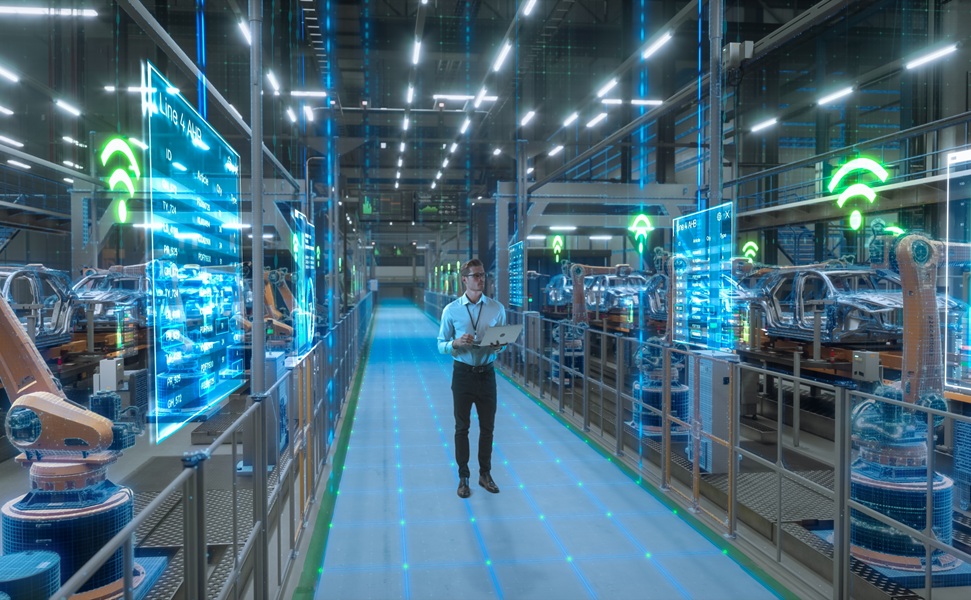
This level of integration is only manageable with advanced digital workflows, simulation, and real-time validation. Red Bull’s long-standing partnership with Hexagon, whose metrology and scanning systems have been integrated into every stage of car build, plays a critical role in managing this complexity.
Tools that change the way you race
Red Bull was one of the earliest users of Hexagon’s tracking systems in the paddock. Originally intended to speed up Friday-night rebuilds between practice sessions, the tools quickly evolved into diagnostic and development aids. “Instead of taking manual measurements to figure out what had shifted or failed, we could scan the car trackside and compare the results with our CAD models back at the factory,” Gray adds. “It let us understand not just that something was out of spec, but why and how.”
That workflow, design, measure, compare, and adjust now forms the basis of how Red Bull Advanced Technologies approaches the RB17. Scanning rigs are used to inspect fit and finish, ensure aerodynamic tolerances, and confirm that the quality experienced by the customer matches the one engineered in the simulation.
And new tools continue to evolve. At Hexagon Global Live in Las Vegas, where Gray shared insights from the RB17 programme, the potential of robotic scanning systems to autonomously inspect panel gaps and surface finishes in a single sweep caught his attention. “I love the idea of a robot walking around the car, inspecting everything in one go,” he says. “That would be a real game-changer for us.”
Shifting expectations for drivers and engineers
The RB17 is not designed for professional racers alone. Thanks to active suspension and aerodynamic systems, it can be tailored in real time to suit the driver’s skill and confidence. Throttle response, understeer bias, and ride height can all be tuned down until the driver is ready to turn them back up. “We want this to be something that drivers grow into. You can start in
a safe, stable mode, then evolve with the car as your experience builds,” Gray says.
This approach reflects a broader truth in manufacturing: advanced performance is no longer about brute force. It is about adaptability, usability, and feedback loops, qualities that are just as critical on the factory floor as they are on a racetrack.
Engineering without a safety net
Many of the challenges Red Bull faces with the RB17 stem from the fact that there is nowhere to hide. The car must deliver every watt of power, every kilogram of downforce, every millimetre of clearance that the simulations predict. There is no buffer and no margin for underperformance. “It only works if every system hits its target,” Gray explains. “That is what makes it exciting and terrifying.”
This mindset of pushing every system to the edge mirrors the pressure on digital manufacturing more broadly. There is a shift away from siloed, process-driven improvement and towards holistic, system-wide optimisation. Companies that once iterated are now expected to innovate. Mistakes cost more. And the demand for precision grows exponentially.
Red Bull’s approach offers a roadmap. It starts with engineering confidence. It scales with advanced tools. And it is fuelled by a belief that if you get every detail right, even the most audacious designs can become reality.
Confidence built on culture
For Gray, the biggest lesson from Formula One is cultural rather than technical. It is the belief that outrageous goals are not impossible if the right people are in place and the right processes support them. “We tend to take on things that, on the surface, feel slightly ridiculous,” he concludes. “But history shows we usually deliver them. We are building our own Formula One engine for next season. We are selling a car like the RB17 to private customers. It all starts with the mindset that we can do it.”
That mindset is what truly connects motorsport and the manufacturing industry. Not the speed or the branding but the pursuit of excellence in every detail, every time. Because in both worlds, the difference between good and great is measured in microns and in the confidence to chase the improbable.